

Revenue cycle management (RCM) in healthcare is the financial process that enables healthcare providers to manage every step of the patient payment journey. The healthcare revenue management cycle covers everything from appointment scheduling and insurance verification to medical billing, claims submission, payment collection, and denial management.
An efficient RCM process helps healthcare practices maintain accurate billing records, reduce claim denials, minimize revenue leakage, and improve cash flow. However, changing insurance requirements, complex billing procedures, and frequent claim rejections can make revenue cycle management challenging.
Key Insights
- What revenue cycle management means in healthcare.
- The key steps involved in the healthcare revenue cycle.
- Goals of revenue cycle management
- Importance of revenue cycle management for healthcare providers
- Benefits of outsourcing revenue management services
- Common revenue cycle management challenges and their solutions.
- Important RCM metrics and KPIs to track.
What is Revenue Cycle Management in Medical Billing
Revenue cycle management in medical billing refers to the complete financial process healthcare providers follow to receive payment for the services they deliver. It begins when a patient schedules an appointment and continues through registration, insurance verification, treatment, coding, claim submission, reimbursement, and final payment collection.
The medical billing process in revenue cycle management ensures that every billable service is properly documented, assigned the appropriate codes, submitted to the correct payer, and reimbursed according to applicable coverage policies and contractual agreements.
For example, when a patient visits a medical practice:
- The administrative team schedules the appointment and collects patient information.
- The billing team verifies insurance eligibility and benefits.
- The healthcare provider documents the examination, diagnosis, and treatment.
- A medical coder assigns the appropriate diagnosis and procedure codes.
- The billing team prepares and submits the insurance claim.
- The insurance company processes the claim and issues payment or an explanation of its decision.
- The practice posts payments, resolves denials, and collects any remaining patient balance.
Phases of the Revenue Cycle Process in Healthcare
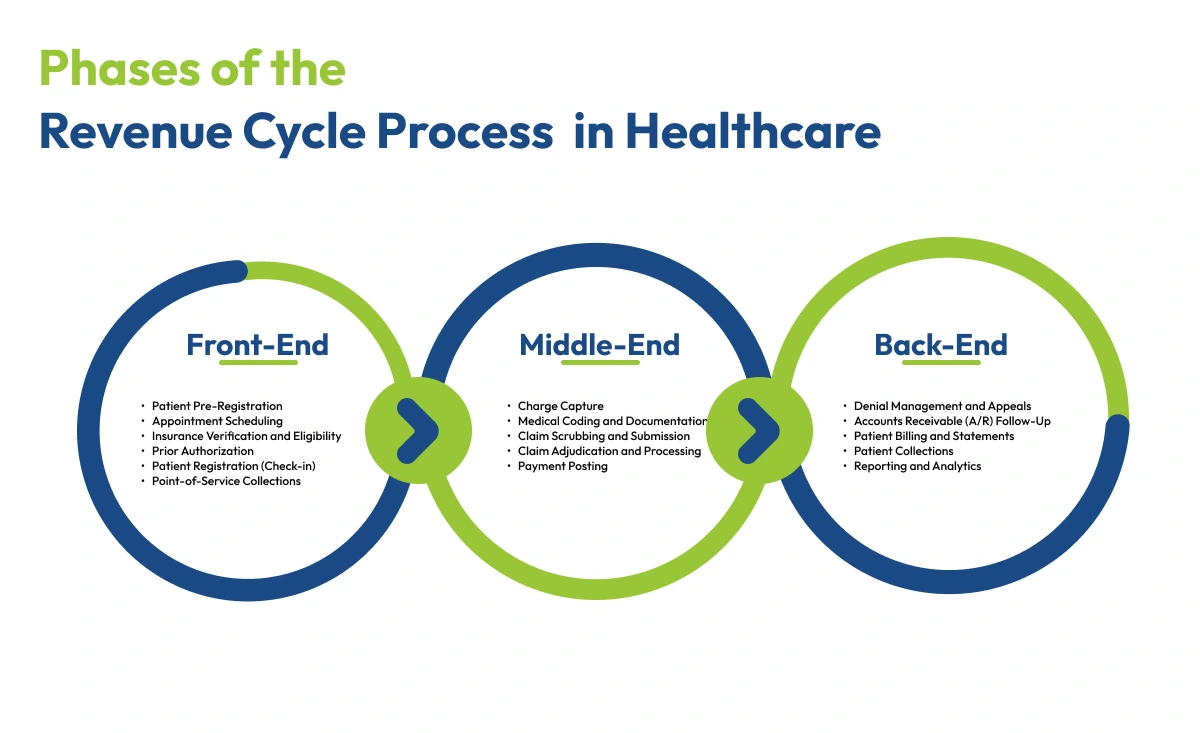
The healthcare revenue cycle management process is generally broken down into three major operational phases. These phases encompass all administrative and clinical functions that contribute to capturing, managing, and collecting patient service revenue.
Phase 1: Patient and Payer Foundation (Front-End)
The front-end phase establishes accurate patient and insurance information before or at the time of service to prevent downstream billing errors. It consists of the following steps.
- Patient Pre-Registration
- Appointment Scheduling
- Insurance Verification and Eligibility
- Prior Authorization
- Patient Registration (Check-in)
- Point-of-Service Collections
Phase 2: Clinical to Financial Translation (Middle-End)
The middle-end phase converts delivered medical services into standardized codes and submits formal claims for payer reimbursement. It involves the following steps.
- Charge Capture
- Medical Coding and Documentation
- Claim Scrubbing and Submission
- Claim Adjudication and Processing
- Payment Posting
Phase 3: Revenue Realization and Optimization (Back-End)
The back-end phase addresses unpaid balances, resolves denials, and collects remaining responsibilities from insurers or patients. It consists of the following steps.
- Denial Management and Appeals
- Accounts Receivable (A/R) Follow-Up
- Patient Billing and Statements
- Patient Collections
- Reporting and Analytics
Key Components of Revenue Cycle Management
Revenue cycle management is the backbone of the financial health of healthcare providers. The revenue cycle process in healthcare integrates administrative, clinical, and financial functions that help healthcare providers manage their financial operations. The components of revenue cycle management play an important role in maintaining accurate billing, reducing claim denials, ensuring timely reimbursements, and improving the financial performance of a healthcare practice.
We will discuss the steps in revenue cycle management in healthcare in detail.
Patient Scheduling
Patient scheduling is the first step in the revenue cycle management process. It comprises:
- Managing appointments
- Coordinating provider availability
- Ensuring patients receive timely access to healthcare services.
An organized scheduling process helps reduce missed appointments, prevent scheduling conflicts, and improve overall front-desk efficiency.
Patient Registration
Patient registration in the healthcare revenue cycle includes collecting and recording accurate demographic, contact, and insurance information before healthcare services are provided.
The registration process generally includes:
- Patient names
- Dates of birth
- Contact information
- Insurance identification numbers
- Subscriber details.
Accurate registration helps prevent claim rejections caused by incorrect patient information. It also gives billing teams the information needed to verify coverage and determine financial responsibilities before appointments
Insurance Eligibility and Verification
Insurance eligibility verification in the healthcare revenue cycle process confirms whether a patient's insurance coverage is active and determines the benefits available for the scheduled service.
In this step, billing teams review:
- Coverage limitations
- Copayments, deductibles
- Coinsurance
- Network participation
- Referral requirements
They may also verify whether specific procedures require prior authorization.
Completing these checks before appointments helps practices identify potential coverage issues, communicate expected patient responsibilities, and reduce avoidable insurance-related claim denials.
Prior Authorization
Prior authorization includes obtaining approval from an insurance payer before providing certain medical services, procedures, medications, or treatments. Healthcare providers may need to submit:
- Clinical notes
- Diagnosis information
- Treatment plans
- Supporting documentation to demonstrate that the requested service meets payer requirements.
A structured authorization process helps prevent authorization-related denials, reduces unnecessary administrative delays, and supports smoother reimbursement.
Medical Coding
Medical coding converts clinical documentation into standardized codes used for healthcare billing and reimbursement. Medical coders review diagnoses, procedures, and services documented by healthcare professionals and assign the appropriate codes.
Common coding systems include:
- ICD-10-CM: Used to classify diagnoses and medical conditions.
- CPT: Used to report medical procedures and professional services.
- HCPCS Level II: Used to identify certain supplies, products, and services not represented by CPT codes.
Accurate medical coding ensures that claims reflect the services documented in the medical record. It also supports appropriate reimbursement and helps healthcare providers maintain coding compliance.
Charge Capture
Charge capture consists of identifying and recording all billable services, procedures, and treatments provided during a patient's visit. Healthcare providers and billing teams review clinical documentation to ensure that every service is accurately documented and assigned the appropriate charge. Effective charge capture prevents missed charges, reduces revenue leakage, and ensures healthcare practices receive appropriate reimbursement for the services they deliver.
Medical Claim Submission
Medical claim submission is the process of preparing and sending healthcare claims to insurance companies for reimbursement. Before submission, billing professionals review:
- Patient information
- Insurance details
- Provider identification
- Diagnosis codes, procedure codes
- Service dates
- Modifiers
- Required supporting documentation.
Claims should also be checked against payer-specific submission guidelines and filing deadlines. Clean claims help minimize processing delays, reduce avoidable rejections, and improve the chances of receiving timely payments from insurance companies.
Payment Posting
Payment posting comprises recording payments received from insurance companies and patients into the practice's billing system. This process includes reviewing
- Explanation of Benefits (EOBs)
- Electronic Remittance Advice (ERAs)
- Applying contractual adjustments, and
- Identifying outstanding patient balances
Accurate payment posting helps maintain updated financial records, identify payment discrepancies, and track the actual reimbursement received for healthcare services.
Denial Management
Denial management in the healthcare revenue cycle focuses on identifying, correcting, and appealing denied insurance claims.
Common denial reasons include
- Incorrect medical coding
- Missing clinical documentation
- Inactive insurance coverage
- Authorization issues
- Duplicate claims
- Timely filing violations
Billing teams investigate denial reasons, correct eligible claims, submit appeals when appropriate, and monitor recurring problems. An organized denial management process helps recover eligible payments and prevent repeated billing errors.
Accounts Receivable (AR) Management
Accounts receivable management is the process of monitoring unpaid insurance claims and outstanding patient balances to ensure payments are collected within appropriate timeframes. Billing teams regularly review aging reports, follow up on delayed claims, investigate payment issues, and communicate with insurance companies. Proactive AR management reduces outstanding balances, shortens the accounts receivable cycle, and improves the healthcare practice's cash flow.
Patient Billing and Collections
Patient billing and collections include generating statements and collecting payments for services not covered by insurance. These may include
- Deductibles
- Copayments
- Coinsurance
- Other outstanding balances
Healthcare providers must clearly communicate payment responsibilities, provide accurate billing statements, and offer convenient payment options. An organized patient collections process improves payment recovery while maintaining positive patient relationships.
Financial Reporting and Analysis
Financial reporting and analysis help healthcare providers evaluate the performance of their revenue cycle operations. Practice administrators and billing teams monitor key performance indicators (KPIs), including
- Days in accounts receivable
- Clean claim rates
- Denial rates
- Net collection rates
- Reimbursement trends
Regular reporting helps identify operational weaknesses, evaluate payer performance, monitor outstanding balances, and make informed decisions about financial planning and resource allocation.
All these steps in revenue cycle management in healthcare work together to create an efficient revenue cycle management process. From patient scheduling and insurance verification to claim submission, payment posting, and collections, every stage contributes to the financial health of a healthcare practice. By optimizing each component, healthcare providers can minimize administrative errors, reduce claim denials, accelerate reimbursements, improve cash flow, and maintain long-term financial stability.
Goals of Revenue Cycle Management
The primary goals of Revenue Cycle Management are to ensure healthcare providers receive accurate and timely payments for the medical services they deliver. It manages every financial step of the patient journey. focus on improving how healthcare providers document services, process claims, collect payments, and manage financial resources.
Improve Cash Flow and Payment Timelines
One of the main goals of RCM is to maintain a steady cash flow by ensuring claims are submitted accurately and payments are collected on time. Efficient billing and follow-up processes help reduce reimbursement delays and outstanding balances.
Minimize Claim Denials and Rejections
RCM aims to prevent avoidable claim denials by identifying errors in patient information, insurance eligibility, medical coding, and claim documentation before submission. This helps healthcare providers improve claim acceptance rates.
Maximize Revenue Collection
An effective revenue cycle ensures that all provided services are accurately documented, coded, and billed. It helps prevent missed charges, underpayments, and revenue leakage while improving overall collection performance.
Lower Administrative Costs
Standardize workflows and leverage automation software to reduce manual paperwork and staff burden. This improves overall staff productivity and lowers the total cost-to-collect per patient visit.
Streamline Administrative Workflows
Another important goal is to simplify billing and administrative operations through organized processes and automation. This reduces repetitive tasks, minimizes manual errors, and allows staff to manage revenue-related responsibilities more efficiently.
Improve the Patient Financial Experience
RCM also focuses on making financial interactions easier for patients through accurate billing statements, transparent payment estimates, and convenient payment options.
Maintain Billing Accuracy and Compliance
Healthcare providers must follow payer guidelines, medical coding standards, and applicable healthcare regulations. RCM helps maintain accurate documentation and compliant billing practices throughout the reimbursement process.
Key Benefits of Outsourced Revenue Cycle Management Services for Healthcare Providers
Outsourcing healthcare revenue cycle management services allows healthcare providers to delegate selected billing and financial operations to an experienced external team. Managing every stage of the revenue cycle internally can require considerable staff time, technical resources, and specialized billing knowledge.
Depending on the service agreement, outsourced revenue cycle management support may include patient eligibility verification, medical coding, charge entry, claim submission, payment posting, denial management, accounts receivable follow-ups, and financial reporting.
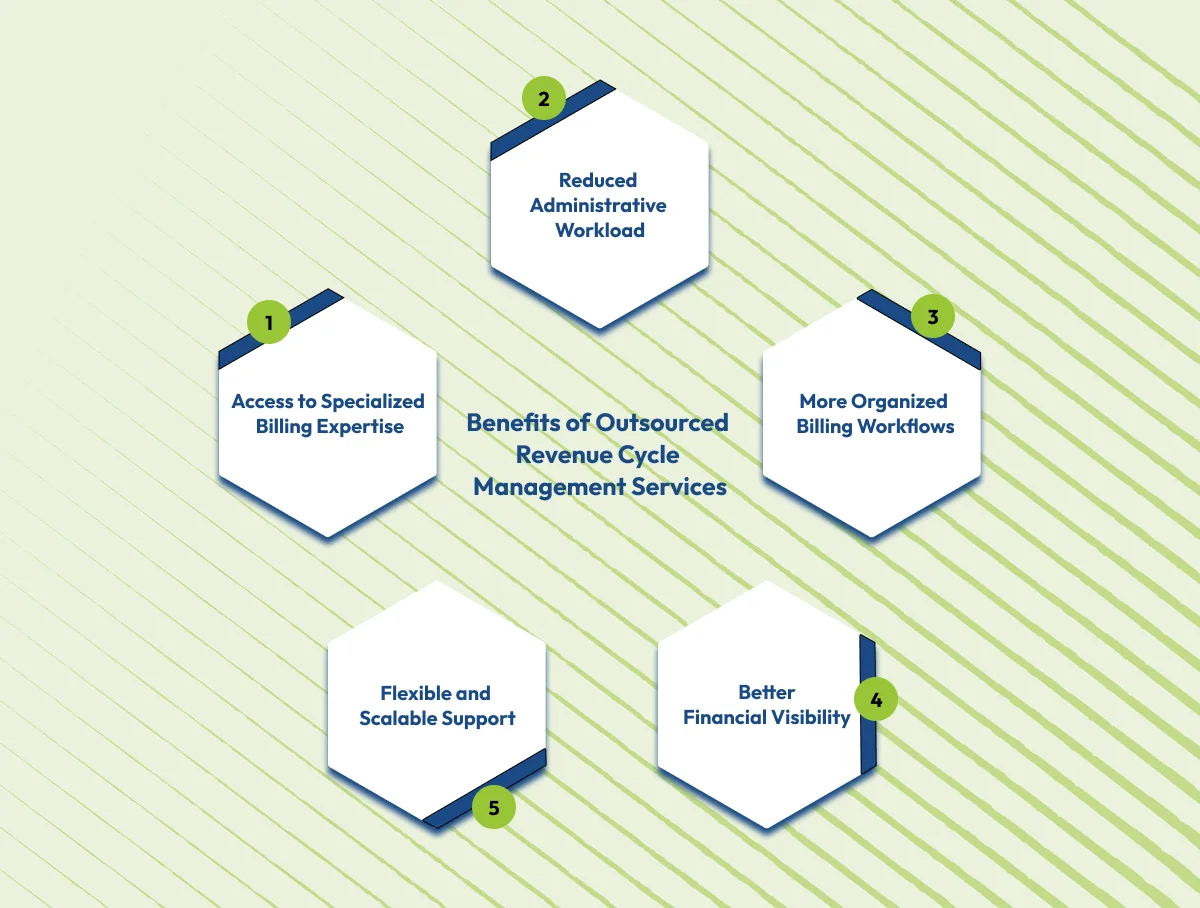
Access to Specialized Billing Expertise
Experienced billing professionals understand medical coding, payer requirements, and claim processing procedures. Their knowledge can help healthcare practices manage complex billing activities and address common reimbursement issues.
Reduced Administrative Workload
Outsourcing can reduce the internal workload associated with managing daily billing activities. This allows healthcare providers and administrative teams to dedicate more time to patient services and practice operations.
More Organized Billing Workflows
Dedicated billing teams can establish structured procedures for claims, payments, denial follow-ups, and outstanding balances. Organized workflows help improve accountability and make it easier to monitor unresolved accounts.
Better Financial Visibility
Regular reporting helps providers monitor billing performance, identify payment discrepancies, and review outstanding accounts. This information supports better financial planning and operational decisions.
Flexible and Scalable Support
Healthcare practices can select outsourced services according to their operational needs. As a practice grows or its billing requirements change, the service arrangement can be adjusted accordingly.
Before outsourcing, healthcare providers should evaluate the vendor's experience, security practices, reporting capabilities, service scope, and ability to meet applicable HIPAA business associate requirements.
Importance of Revenue Cycle Management in Healthcare
Revenue Cycle Management is essential for maintaining the financial health and operational stability of healthcare providers. The importance of revenue cycle management in healthcare can not be ignored. Every medical practice depends on accurate billing, timely reimbursements, and effective payment collection to cover operating expenses and continue delivering quality care.
We will discuss how revenue cycle management is important for healthcare providers.
Ensures Financial Stability
A properly managed revenue cycle helps healthcare providers maintain consistent income by improving billing accuracy, tracking payments, and reducing reimbursement delays. This financial stability supports daily operations and long-term planning.
Prevents Revenue Leakage
Missed charges, incorrect coding, and incomplete documentation can result in lost revenue. RCM helps identify these issues and ensures that all eligible services are accurately captured and billed.
Supports Regulatory Compliance
Healthcare billing involves complex coding standards, payer policies, and regulatory requirements. Effective RCM practices help providers maintain accurate records and follow applicable billing and documentation guidelines.
Improves Claims Management
Monitoring claims from submission through final adjudication allows billing teams to identify unpaid, rejected, or denied claims. Timely intervention helps resolve payment issues and prevent unnecessary delays.
Effective claims management helps providers:
- Track claim status throughout the reimbursement process.
- Identify rejected and denied claims promptly.
- Submit corrected claims when necessary.
- Follow up on outstanding insurance payments.
Strengthens Healthcare Practice Management
Accurate financial reports and performance metrics give healthcare administrators a clearer understanding of their practice's financial position. This information supports better decisions regarding staffing, budgeting, and resource allocation.
Protects Resources for Patient Care
Efficient revenue cycle operations help healthcare providers maintain the financial resources needed for medical equipment, staffing, technology, and patient services. This allows providers to focus more effectively on delivering quality care.
Promotes Long-Term Business Growth
A reliable RCM process creates a stronger financial foundation for healthcare practices. Improved collections, controlled administrative costs, and predictable revenue help providers expand services and support sustainable business growth.
Healthcare Revenue Cycle Management Challenges and Solutions
Healthcare Revenue Cycle Management is a complex process, so it faces major operational, financial, and technical challenges. These revenue cycle management challenges can affect the financial performance and operational efficiency of medical practices. Complex payer requirements, changing coding guidelines, insurance verification errors, and delayed reimbursements can make it difficult to maintain an efficient billing process.
We will discuss the challenges of revenue cycle management in healthcare and their solutions.
Frequent Claim Denials and Rejections
Claim denials are among the most common challenges in healthcare billing. Incorrect coding, missing documentation, inaccurate patient information, and authorization problems can lead to denied or rejected claims.
Repeated denials increase administrative workloads, delay reimbursement, and require additional time for investigation, correction, and resubmission.
Solution
- Deploy automated billing software to validate codes, modifier rules, and patient information against payer guidelines before submission.
- Create a dedicated task force to track denial patterns, identify root causes, and build an appeals checklist to speed up rework.
- Train clinicians to document specific medical necessities directly in the EHR to eliminate missing documentation issues.
Insurance Eligibility and Verification Errors
Outdated policy information, inactive coverage, and incorrect benefit details can create billing complications. When insurance eligibility is not checked before appointments, providers may encounter unexpected denials or difficulties determining patient financial responsibilities.
Solution
- Integrate automated RTE tools into your scheduling system to check patient insurance status and active benefits automatically 48 to 72 hours before the appointment.
- Use online patient portals that require patients to upload photos of their insurance cards and update personal data prior to their arrival.
- Establish a firm front-desk policy to calculate and collect known patient copays and deductibles at the time of service rather than billing later.
Complex Medical Coding Requirements
Healthcare providers must maintain accurate diagnosis and procedure coding while following applicable coding guidelines and payer-specific requirements. Keeping up with annual coding updates, specialty-specific procedures, and documentation standards can be particularly challenging for practices handling multiple specialties.
Solution
- Utilize encoding software that scans clinical notes for specific medical keywords and matches them to ICD-10-CM, CPT, and HCPCS codes.
- Hire certified coders or outsource to specialized vendors who focus explicitly on your practice’s unique medical specialties.
- Provide structured, mandatory refresher training for coding teams every time CMS or payers update their annual guidelines.
Delayed Reimbursements
Incomplete claims, payer processing delays, and insufficient follow-ups can extend reimbursement timelines. These delays increase accounts receivable balances and may create cash flow pressure, particularly for smaller healthcare practices.
Solution
- Aim for a first-pass clean claim Rate by auditing rejected claims weekly to discover and fix systemic processing friction.
- Ensure all possible payers are set up for electronic claims submission and Electronic Funds Transfer (EFT) to bypass physical mail delays.
- Create a hard deadline, such as 15 days post-submission, where staff must automatically call or message a payer to investigate an unacknowledged claim.
Inefficient Accounts Receivable Management
Unpaid claims and outstanding patient balances can accumulate when billing teams do not consistently monitor accounts receivable. Without a structured follow-up process, healthcare providers may also miss payer deadlines for corrected claims or appeals.
Solution
- Organize outstanding claims by age (30, 60, 90+ days) and financial value so billing teams can prioritize high-dollar, aging claims first.
- Program your practice management system to send push notifications and alerts when timely filing or appeal deadlines are approaching.
- Move away from paper statements by texting or emailing secure payment links, and offer automated, interest-free payment plans for large balances.
Regulatory and Compliance Risks
Healthcare providers must protect patient information and maintain appropriate documentation, coding, and billing practices. Failure to follow applicable requirements can lead to audits, payment recoupments, financial penalties, and other consequences.
Solution
- Perform random, monthly audits of coding and billing samples to identify vulnerabilities before external entities conduct an official audit.
- Keep a cloud-accessible, master digital matrix of all commercial payer contracts so staff always know current compliance boundaries and reimbursement rates.
- Ensure strict HIPAA compliance by restricting EHR and billing system data access solely to staff members who require it for their daily tasks.
Manual Processes and Limited Staff Resources
Manual data entry, disconnected software systems, and limited billing staff can increase errors and slow down administrative operations. These limitations may affect claim submission, payment posting, denial follow-ups, and patient collections.
Solution
- Adopt an interconnected software suite to allow patient demographic, clinical, and billing data to flow seamlessly without double data entry.
- Partner with a specialized outsourced revenue cycle management provider to absorb labor-intensive tasks like credentialing or secondary claims chasing.
Key Performance Indicators of Healthcare Revenue Cycle Management for Medical Practices
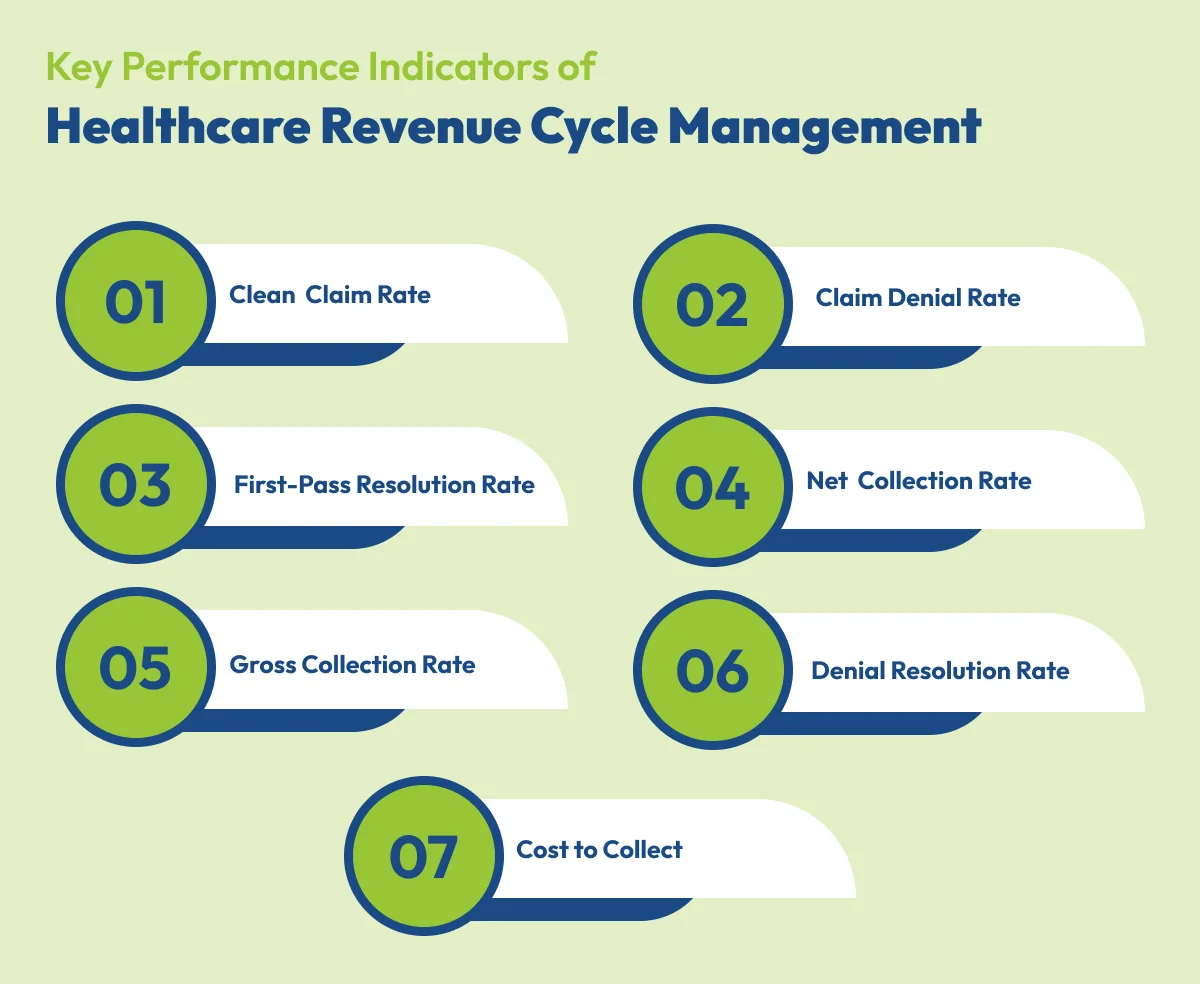
Key performance indicators of the healthcare revenue management cycle play an important role in a medical practice's financial health. They help healthcare providers evaluate financial performance, measure billing efficiency, and identify operational weaknesses.
Monitoring these indicators regularly allows administrators to assess whether their RCM processes are working effectively.
Days in Accounts Receivable
Days in accounts receivable is an important KPI of the healthcare revenue management cycle. It measures the average time a practice takes to collect payments after services are provided or billed. A lower figure can indicate more efficient payment collection, although results should be interpreted alongside payer mix, billing practices, and the organization's financial reporting methodology.
Clean Claim Rate
The clean claim rate measures the percentage of submitted claims that pass initial processing without requiring corrections or additional information. A higher clean claim rate generally indicates better patient registration, documentation, coding, and claim preparation.
Claim Denial Rate
The claim denial rate measures the percentage of submitted claims denied by insurance companies within a defined reporting period. Practices should establish a consistent measurement method, such as tracking denials by claim count or denied dollar value, to evaluate performance accurately.
First-Pass Resolution Rate
The first-pass resolution rate measures the proportion of claims processed successfully without requiring additional correction or resubmission. This metric helps healthcare providers evaluate the effectiveness of front-end registration, coding, and billing procedures.
Net Collection Rate
The net collection rate measures the percentage of collectible revenue actually received after accounting for contractual adjustments. It helps providers evaluate how effectively their practice collects the amounts it is entitled to receive under applicable payer agreements.
Gross Collection Rate
The gross collection rate compares total payments received with total charges billed. It provides a broad overview of collection performance before contractual adjustments are considered.
Denial Resolution Rate
The denial resolution rate measures the proportion of denied claims successfully resolved through corrections, appeals, or other appropriate actions. It helps healthcare providers evaluate their denial management processes and identify opportunities to recover eligible payments.
Cost to Collect
Cost to collect measures the administrative expenses associated with collecting healthcare revenue. Monitoring this metric helps providers evaluate billing efficiency, identify unnecessary expenses, and determine opportunities to streamline financial operations.
Important Revenue Cycle Management Compliance in Healthcare
Revenue cycle management compliance involves following applicable federal and state regulations, payer requirements, coding guidelines, documentation standards, and patient privacy rules throughout the financial process.
It is important because inaccurate documentation, unsupported coding, and improper billing practices can result in claim denials, payment recoupments, audits, financial penalties, and reputational damage.
Below, you will find how practices can maintain healthcare revenue cycle compliance.
Maintain Accurate Clinical Documentation
Clinical records should clearly support the diagnoses, procedures, and services reported on insurance claims. Complete documentation helps billing teams verify medical necessity and respond to payer requests for additional information.
Follow Medical Coding Guidelines
Healthcare providers should follow applicable ICD-10-CM, CPT, and HCPCS coding requirements. Regular coding reviews and staff training help ensure that claims accurately represent the services provided.
Follow HIPAA Privacy and Security Requirements
Patient health information must be handled according to applicable privacy and security requirements. Healthcare providers should maintain appropriate safeguards, access controls, and business associate agreements where required.
Conduct Regular Billing and Coding Audits
Regular audits help identify coding inconsistencies, missing documentation, duplicate billing, and other potential compliance concerns. Addressing these issues early can reduce financial and operational risks.
Monitor Regulatory and Payer Updates
Insurance policies, coding requirements, and healthcare regulations can change over time. Billing teams should monitor official updates to ensure that claims and documentation practices remain aligned with applicable requirements.
How Ascent MB Supports Revenue Cycle Management for Healthcare Providers
Managing medical billing and reimbursement requires accuracy, consistency, and an understanding of healthcare payer requirements. Ascent MB provides medical billing and revenue cycle management for healthcare providers to help practices organize their financial operations and manage essential billing activities.
Our services support important revenue cycle functions, including medical coding, claim preparation, claim submission, payment posting, denial management, and accounts receivable follow-ups. By supporting these activities, we help healthcare practices manage administrative workloads, improve billing accuracy, and organize reimbursement operations more efficiently.
Optimize Your Revenue Cycle Management and Reduce Billing Errors
Stop letting simple mistakes drain your bottom line. Ascent MB optimizes your revenue cycle management and accelerates your practice reimbursements. Ensure total compliance with our end-to-end RCM solution.
Let’s talkConclusion
Revenue cycle management in healthcare is an essential part of maintaining the financial health of practices. It connects patient registration, insurance verification, clinical documentation, medical coding, claim submission, payment posting, denial management, and collections into one coordinated financial process. Although healthcare providers face challenges such as complex payer requirements, claim denials, coding errors, delayed reimbursements, and compliance risks, a structured RCM strategy can help address these issues.